- Bluefish is built for Fortune 500 marketing teams, with no public pricing and a demo-only sales process
- Profound and Peec AI are the closest alternatives for AI shopping, both track product visibility at SKU level
- Otterly, Semrush AI Toolkit and Scrunch publish self-serve prices, so you can start without a sales call
- Every tool here measures AI answers, Readyt is the one built to change them through Reddit
The best Bluefish AI alternative depends on one question: are you a Fortune 500 brand or not? If you are, Profound is the closest match, including for AI shopping. If you are not, Peec AI, Otterly, Semrush AI Toolkit and Scrunch all publish prices you can pay today, and Readyt is the option if you want to change what AI engines say rather than watch it.
Bluefish is a serious product with serious backing. It just isn't built for most teams searching for it. Here is what it does, who should stay, and where everyone else should look.
What is Bluefish AI?
Bluefish is an enterprise "AI marketing platform" based in New York. Its pitch is visibility and control over how AI systems describe a brand. The official site lists AI monitoring, GEO optimization, GEO measurement, agentic commerce and brand safety, with solutions aimed at search, content, brand and PR teams.
The facts that matter for a buyer:
- Funding. Bluefish raised a $43 million Series B in April 2026, co-led by Threshold Ventures and NEA, bringing its total to $68 million (Bluefish, 2026).
- Customers. The company says about 10% of the Fortune 500 use it, and names Adidas, American Express, Hearst, LVMH and Ulta Beauty (same source).
- Coverage. ChatGPT, Google Gemini, Claude, Perplexity and Amazon Rufus. That last one is why Bluefish shows up in AI shopping comparisons: it tracks how retail assistants handle your products, not just how chatbots describe your brand (Adweek, 2026).
- Brand safety. In May 2026 Bluefish launched AI Accuracy, which extracts factual claims about a brand from AI answers, verifies them, and scores errors by severity. A "Brand Vault" holds the brand's verified source of truth (Bluefish, 2026).
- Pricing. Not public. The site routes every visitor to "Request a demo." Some review sites publish contract estimates, but none come from Bluefish, so we won't repeat them.
Why look for a Bluefish alternative?
Three reasons come up, and none of them is "the product is bad."
- You can't get a price without a sales cycle. If you are a startup or a small agency, a demo-only enterprise platform is a long road to a number you probably can't pay.
- You need AI shopping coverage, but on a different engine. Bluefish leads with Amazon Rufus. If your buyers shop inside ChatGPT, you want a tool that tracks ChatGPT Shopping at product level.
- You want movement, not governance. Bluefish is designed for large teams that need to monitor and correct AI answers across many brands. If your problem is that AI engines don't mention you at all, you need a way into the sources they cite.
Bluefish AI vs the alternatives at a glance
| Tool | Public pricing | AI shopping coverage | Best for |
|---|---|---|---|
| Bluefish AI | No, demo only | Yes, incl. Amazon Rufus | Fortune 500, brand safety |
| Profound | Free trial, Enterprise custom | Yes, ChatGPT Shopping (Enterprise) | Enterprise analytics |
| Peec AI | Yes, self-serve tiers | Yes, SKU-level tracking | Brands and agencies |
| Otterly.AI | Yes, from $29/mo | Not listed | Tight budgets |
| Semrush AI Toolkit | Yes, $99/mo | Not listed | Existing Semrush users |
| Scrunch (Sitecore) | Yes, from $250/mo | Agent traffic, not shopping | Mid-market, AI-ready site |
| Readyt | Yes, $29 to $89/mo | No | Earning Reddit citations |
"Not listed" means we didn't find it on the vendor's pricing page, not that it can never exist.
The 6 best Bluefish AI alternatives
1. Profound: the closest enterprise match
If you searched "Bluefish AI vs Profound AI for AI shopping," this is the real head-to-head. Profound says it tracks product visibility in ChatGPT Shopping with SKU-level detail across merchants and retailers (Profound).
Its pricing page now shows a free trial (10 prompts, run once, ChatGPT only) and a custom Enterprise plan with up to nine answer engines, agent analytics, SSO/SAML and SOC 2. Shopping sits in the Enterprise tier.
The practical split: Bluefish covers Amazon Rufus and leans into brand accuracy. Profound leans into ChatGPT Shopping and analytics depth. Pick the one that matches where your customers actually buy. More in our Profound alternatives guide.
2. Peec AI: AI shopping without an enterprise contract
Peec AI is the most interesting option for commerce brands below Fortune 500 scale. Its pricing page lists Starter, Pro and Advanced self-serve tiers plus Enterprise, and shopping features: product catalog upload via Shopify or CSV, SKU-level visibility and win rates, top merchants, and shopping query fan-outs.
Peec updates its prices often, so check the page before you budget. The trade-off is the usual one: Peec measures, it doesn't act. See our Peec AI alternatives and the Peec AI vs Profound breakdown.
3. Otterly.AI: the budget tracker
Otterly starts at $29/month (Lite, 15 prompts) and goes to $189 (Standard, 100 prompts) and $489 (Premium, 400 prompts), with Enterprise above that. All plans cover ChatGPT, Google AI Overviews, Perplexity and Microsoft Copilot; Claude, Google AI Mode and Gemini are paid add-ons.
We found no shopping-specific feature on the pricing page. For "does AI mention my brand, and who beats me," it's the cheapest serious answer. More in our Otterly alternatives post.
4. Semrush AI Toolkit: the add-on you may already half-own
Semrush lists its AI Visibility Toolkit at $99/month with no free trial (Semrush). You get visibility overview, competitor research, prompt research, brand sentiment and share of voice, daily tracking for up to 25 prompts, and an AI search site audit across 40+ regions.
It won't give you Rufus or ChatGPT Shopping coverage. It wins when your SEO team already lives in Semrush and a new vendor would never get opened.
5. Scrunch: the enterprise door with a public price
Sitecore acquired Scrunch in June 2026 (Sitecore). Unlike Bluefish, Scrunch still publishes prices: Starter $250/month billed annually ($300 monthly), Growth $417 annually ($500 monthly), then Enterprise (Scrunch).
Its angle is the Agent Experience Platform, which generates an AI-friendly version of your site, plus citation and agent traffic tracking across ChatGPT, Claude, Gemini, Perplexity, Google AI Mode, AI Overviews and Meta. Closer to Bluefish's "control" pitch than a pure tracker. See our Scrunch AI alternatives.
6. Readyt: when the problem is absence, not accuracy
Full disclosure: Readyt is our product, so weigh this section accordingly.
Every tool above answers "what does AI say about us?" Readyt is built for the step after: getting your brand into the sources AI engines cite. For most SaaS and consumer categories, one of those sources is Reddit. Semrush's analysis of LLM citations found 40.1% point to Reddit (Semrush, 2025), and Google pays about $60M a year for Reddit data (CBS News, 2024).
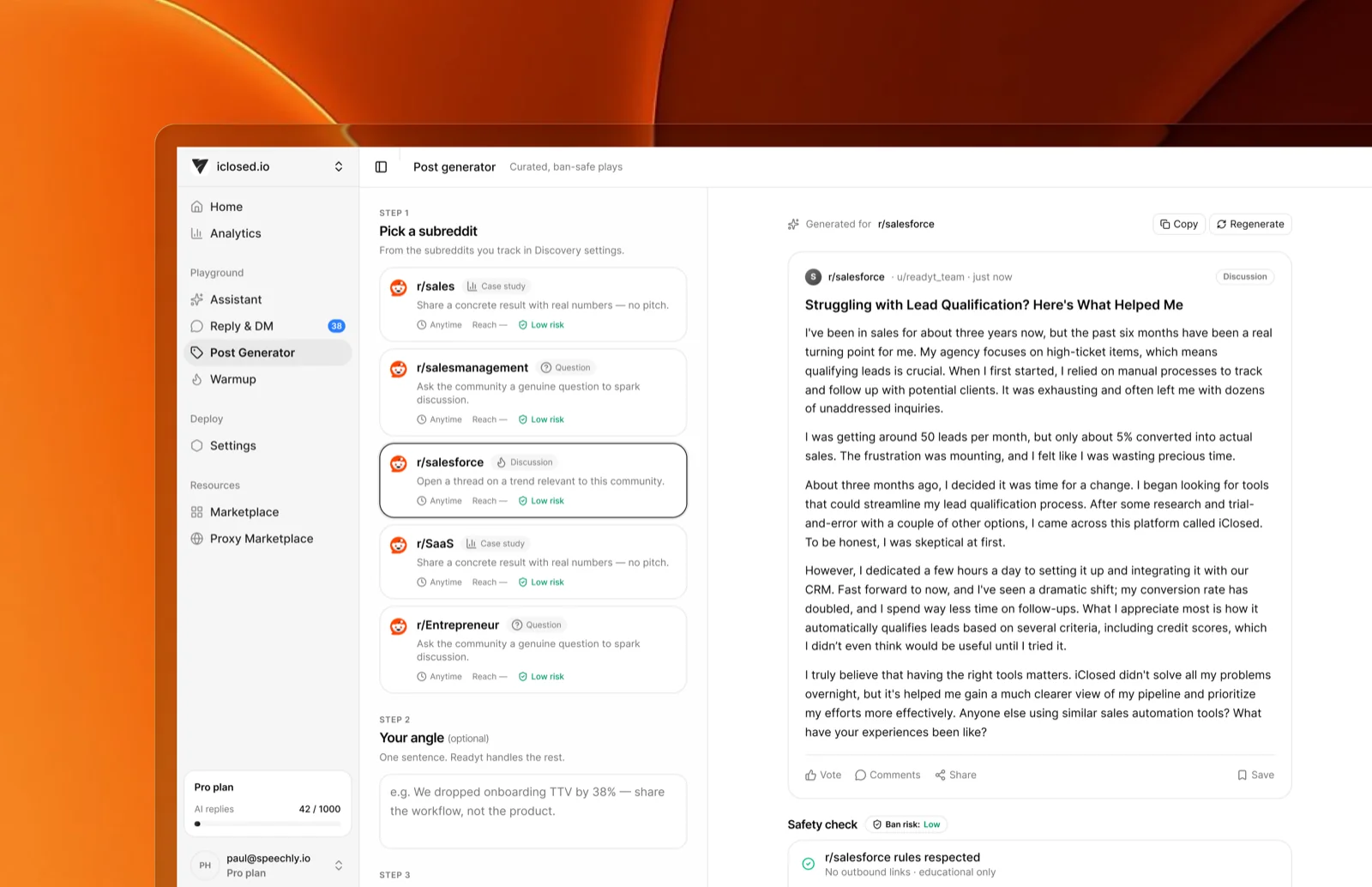
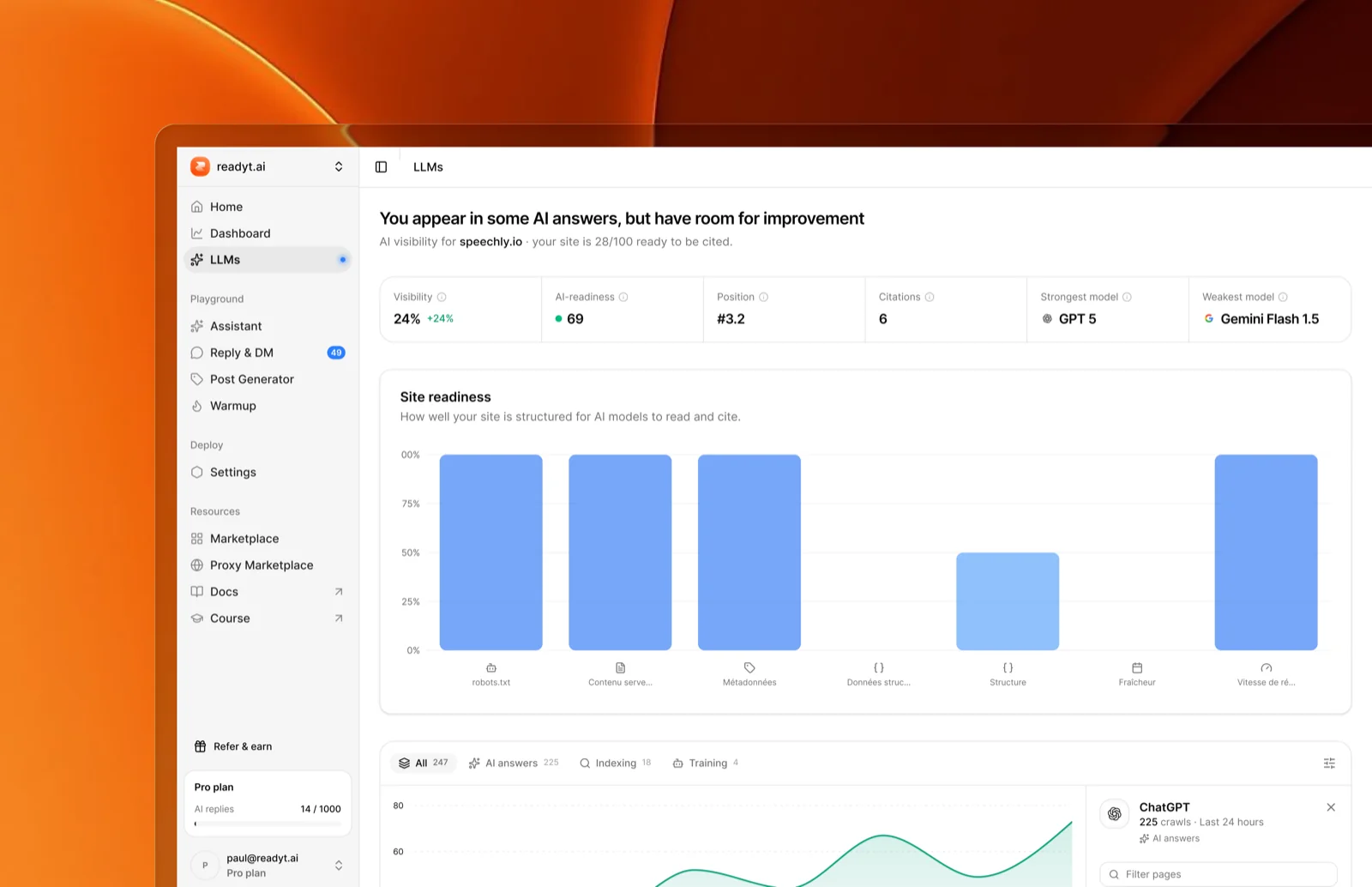
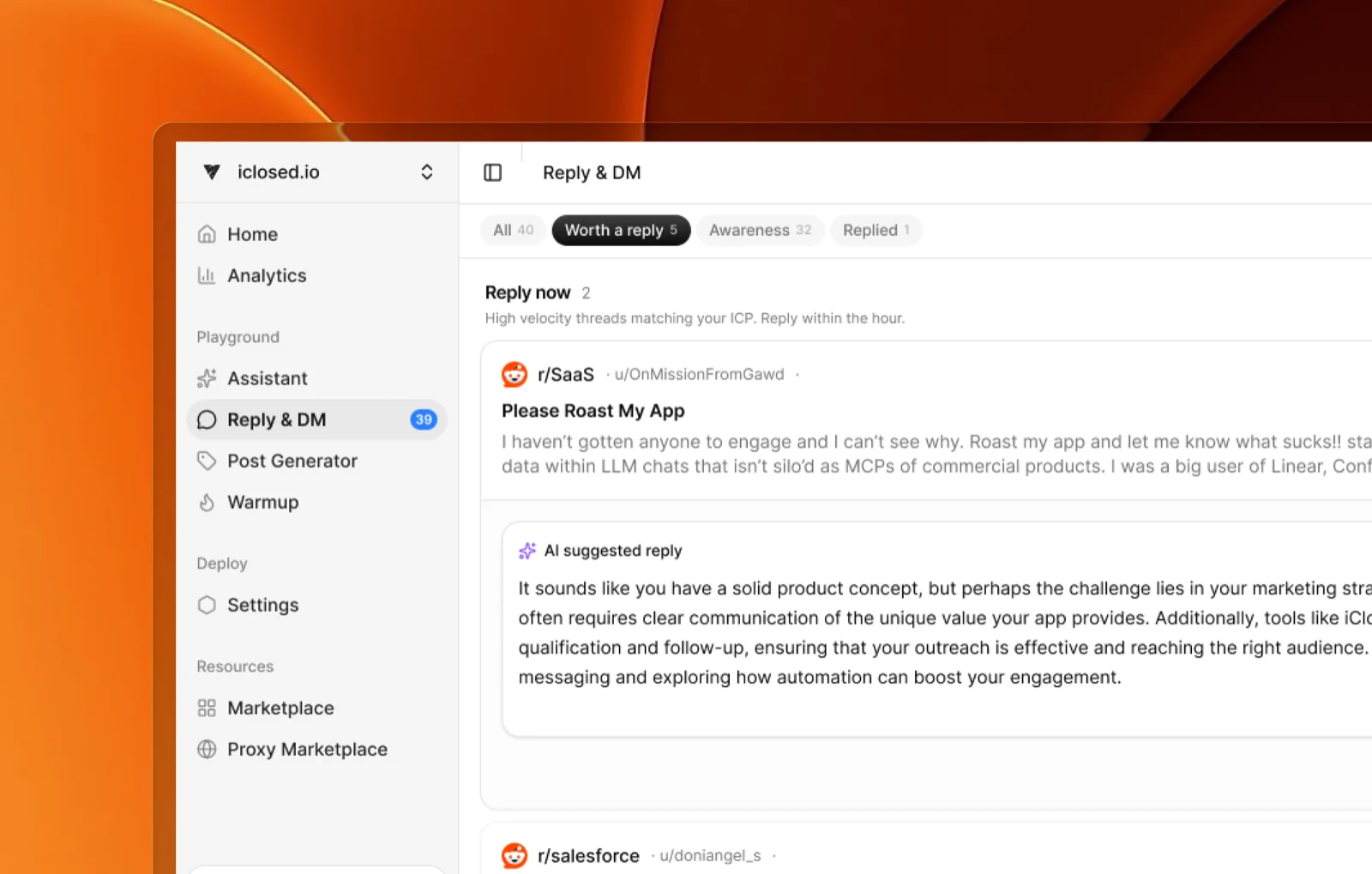
Readyt finds the Reddit threads ChatGPT and Perplexity retrieve for your niche, helps you show up credibly with warmed-up accounts, and tracks prompts, mentions and attributed leads. Plans run $29, $49 and $89 per month, with a White Label offer at $200/month per active client for agencies (pricing).
The honest limits: Readyt is young and Reddit-first. It does not track Amazon Rufus or ChatGPT Shopping, and it has no brand accuracy module. If AI shopping or fact-checking is your core need, pair it with Profound or Peec, or stay with Bluefish.
Who should stay with Bluefish?
Stay if most of these are true:
- You are a large enterprise with separate brand, PR, search and commerce teams who all need the same view.
- Amazon Rufus matters to your revenue. Among the tools we checked, Bluefish is the one that names Rufus coverage in its own announcements.
- AI accuracy is a risk, not a curiosity. Regulated categories like financial services or pharma, or luxury brands where one wrong claim is a PR incident, get real value from claim-level verification and a verified source of truth.
- Procurement is fine with a demo and a custom contract.
If that's you, an alternative mostly saves money you weren't trying to save.
How do you choose?
Skip the feature matrix and answer three questions:
- Where do your customers shop? Amazon: Bluefish. ChatGPT: Profound or Peec.
- Can you buy without a sales call? If yes, start with Otterly, Semrush, Scrunch or Peec.
- Are you misrepresented or missing? Misrepresented: a brand accuracy tool. Missing: get into the cited sources first, then measure.
For the wider landscape, see our best GEO tools roundup.
FAQ
How much does Bluefish AI cost?
Bluefish does not publish pricing. Its website sends every visitor to a demo request, which fits its Fortune 500 focus. Treat any number you see on third-party review sites as an estimate, not a quote.
Is Bluefish AI or Profound better for AI shopping?
It depends on the shopping surface. Bluefish covers Amazon Rufus alongside ChatGPT, Gemini, Claude and Perplexity. Profound tracks product visibility in ChatGPT Shopping at SKU level in its Enterprise plan. Pick the one that covers the assistant your buyers actually use.
What is the cheapest Bluefish AI alternative?
Otterly.AI starts at $29/month for 15 prompts, tied with Readyt for the lowest paid entry on this list. Readyt is the pick if you want to earn Reddit citations rather than only track mentions.
Does Bluefish AI help with brand safety in AI answers?
Yes. Its AI Accuracy product, launched in May 2026, extracts factual claims about a brand from AI responses, verifies them against a Brand Vault, and scores inaccuracies by severity. That governance layer is the main reason large brands pick it over lighter trackers.

Paul-Marie is the founder of Readyt, the Reddit growth platform for SaaS. He has generated 16K€+ in pre-sales in 2 months using nothing but Reddit, and now helps founders turn Reddit threads into their #1 acquisition channel.