- Profound starts around $399/mo and is built for enterprise brands, most startups don't need that depth
- Readyt ($29), Peec (~€89) and Otterly (the budget tracker of the group) cover the same core job at startup prices
- Every tracker measures AI visibility, Readyt is the only tool on this list that also acts on Reddit to win citations
- You can start at $0 with Readyt's free AI Visibility Checker and Reddit Leads Finder
Yes, you can get serious AI visibility coverage without an enterprise contract. Profound starts around $399/month and climbs into custom deals; credible alternatives start at $29/month, and a first baseline costs $0 with free tools.
That gap is the whole story: Profound is strong for large brands, but founders and small agencies pay for governance and analytics depth they'll never open.
We've tested most entry tiers ourselves. Here's the map.
How we picked these alternatives
Three filters, applied in order.
First, the tool has to actually do Profound's core job: track whether AI engines mention your brand when someone asks a buying question. A generic SEO rank tracker with an "AI" tab does not qualify.
Second, the price has to be knowable without a sales call, or the tool has to earn its place for another reason. Two entries on this list are sales-led, and we say so plainly rather than hiding them.
Third, we only claim what we can stand behind. Where a vendor publishes its pricing, we quote it. Where it doesn't, we describe the posture instead of inventing a number. If you see a competitor roundup with a precise dollar figure next to every sales-led tool, that number was guessed.
Is Profound worth $399+ a month?
For the right buyer, yes. Profound is the enterprise reference for AI answer tracking: deep prompt and agent analytics, plus the reporting and security layers procurement asks about. Their research is excellent: a study of 680 million AI citations found Reddit was the most-cited domain on both Perplexity (6.6% of citations) and Google AI Overviews (Profound, 2025).
Stay with Profound if you're an enterprise brand with multiple products and markets, a budget where $399+ is a rounding error, deep analytics needs, and procurement requirements.
If that's not you, keep reading: most startups don't leave Profound over features, the pricing conversation just ended fast.
What do you actually give up by leaving Profound?
An honest list, because switching on price alone and discovering the gap later is how teams end up paying twice.
You give up breadth of surface coverage. Profound tracks a wide set of engines and answer formats. Most sub-$100 tools cover ChatGPT, Perplexity and Google AI Overviews well, and thin out after that.
You give up prompt volume. Entry tiers everywhere are metered. If you genuinely need to track hundreds of prompts across several markets and languages, the cheap tiers will pinch, and stacking add-ons erodes the saving.
You give up procurement comfort. SOC 2 questionnaires, SSO, custom contracts, a named contact: enterprise buyers need these, and young tools often can't tick every box yet.
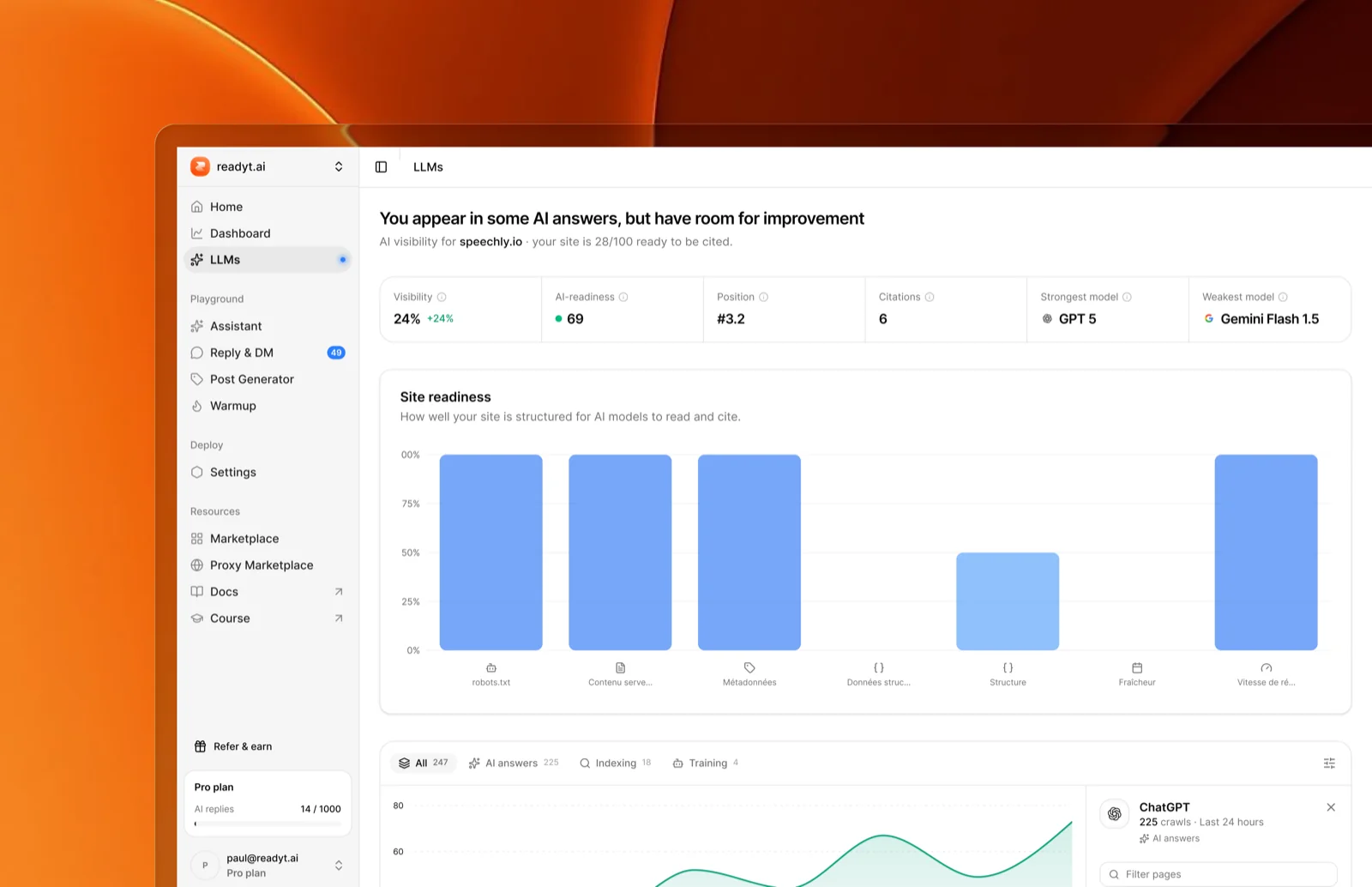
What you generally do not give up is the core signal. Whether AI engines mention you, roughly where you sit against competitors, and which sources they cite: that arrives fine at $29 to €89. The depth you lose is analytical depth, not directional truth.
Who are Profound's main competitors?
Profound sits in a category that barely existed two years ago, so "competitor" splits into three groups worth naming separately.
Direct trackers solve the same problem the same way: Peec AI is the closest transparent-pricing equivalent, and Otterly.AI plays the same game further down market. These are the tools you compare feature by feature.
Suite add-ons come from SEO platforms bolting AI visibility onto an existing subscription: Semrush AI Toolkit and SE Ranking. They rarely win on depth, and often win on the invoice you already pay.
Enterprise neighbours compete for the same budget with a different shape: Scrunch AI, now part of Sitecore, is prescriptive where Profound is analytical.
Readyt sits deliberately outside all three: it is the only tool here whose job is to change the number rather than report it. Which group you should shop in depends entirely on whether your problem is measurement or absence.
What are the 7 best affordable Profound alternatives?
The comparison in one view:
| Tool | Starting price | Best for | Measures or acts? |
|---|---|---|---|
| Readyt | $29/mo | Citations, not just charts | Acts + measures |
| Peec AI | ~€89/mo | Agencies, mid-market | Measures |
| Otterly.AI | Entry plan priced for bootstrappers | Tight budgets | Measures |
| Semrush AI Toolkit | Add-on | Semrush customers | Measures |
| SE Ranking | Suite plans | SEO + AI in one bill | Measures |
| Scrunch AI (Sitecore) | Sales-led | Enterprise, not Profound-shaped | Measures + recommends |
| Readyt free tools | $0 | Anyone starting today | Baseline check |
1. Readyt, from $29/month: the only one that acts, not just measures
Full disclosure: Readyt is our product, weigh this section accordingly.
Readyt starts at $29/month (Growth $29, Pro $89, pricing page), plus a white label offer at $200/month per active client. It leads this list for a reason beyond price: the other tools measure your AI visibility, Readyt is built to change it.
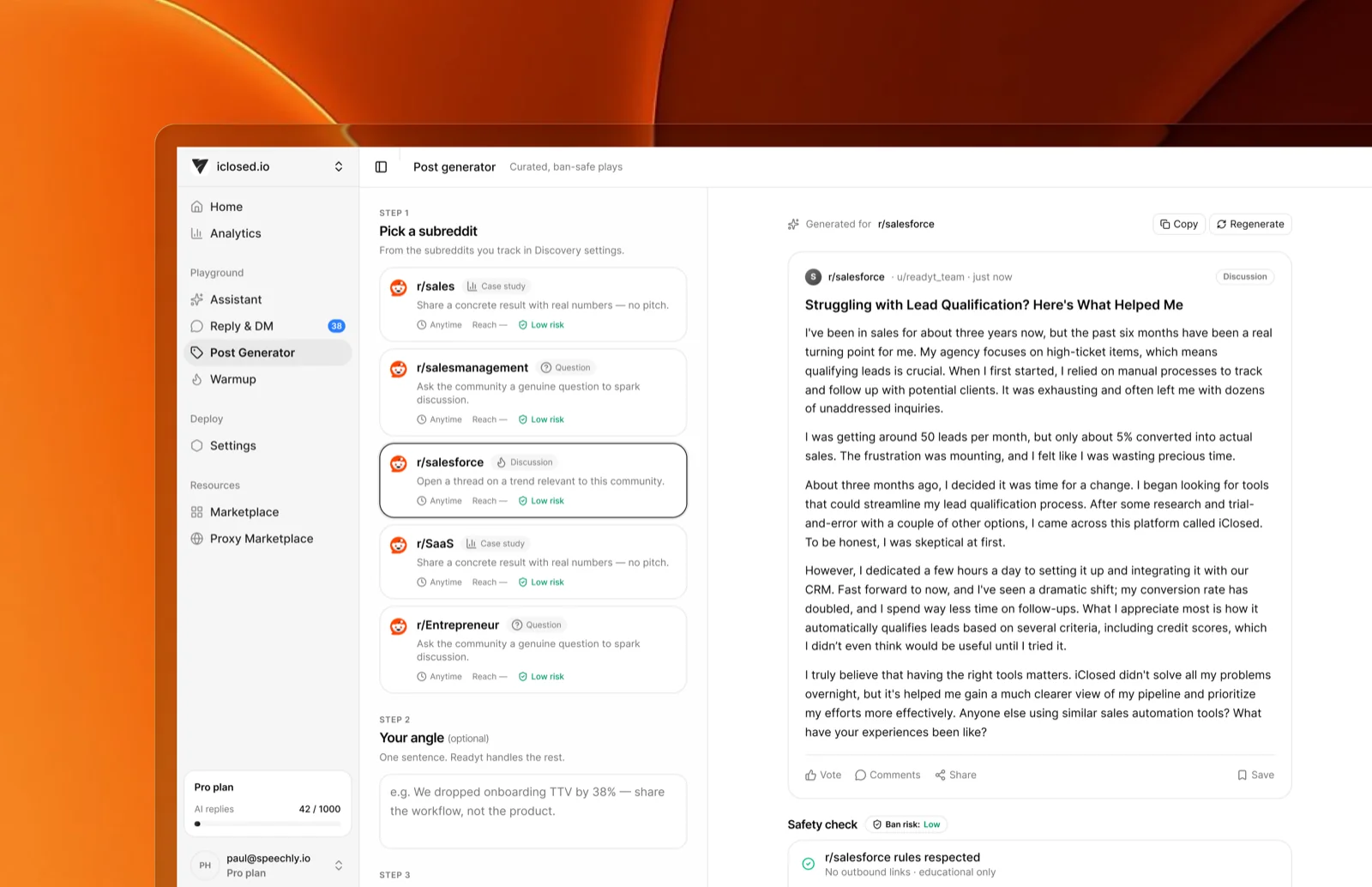
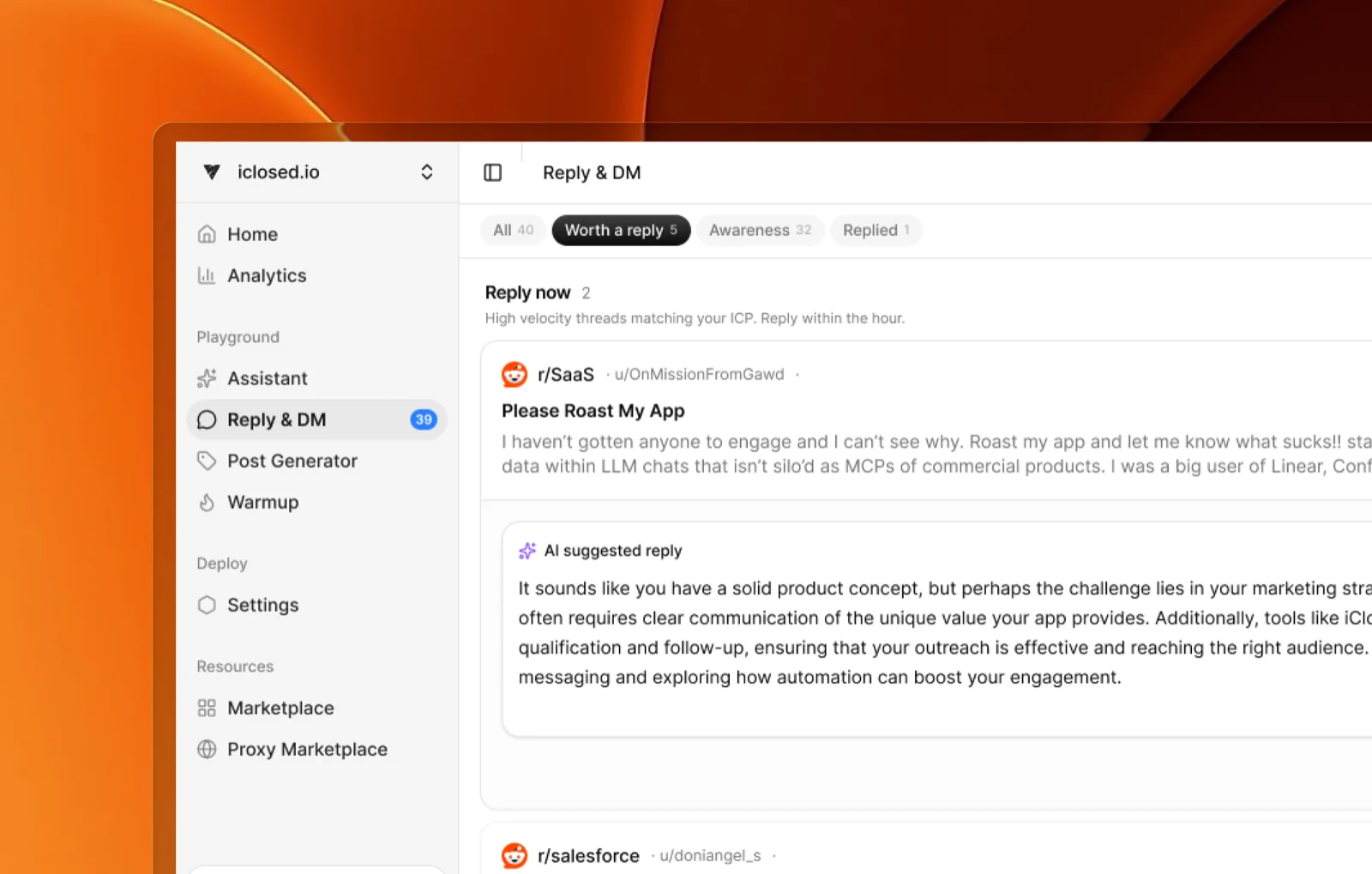
The logic: Semrush analyzed 150,000+ LLM citations and found 40.1% point to Reddit, ahead of Wikipedia (26.3%) and YouTube (23.5%) (Semrush, 2025). So Readyt finds the Reddit threads ChatGPT and Perplexity actually retrieve for your niche, helps you show up credibly (15 minutes a day, warmup included), then tracks prompts, mentions and attributed leads.
Google pays about $60M a year to train its models on Reddit posts (CBS News, 2024), and OpenAI signed its own Reddit partnership the same year. The engines literally pay to read the threads your buyers post in.
The honest limits: Readyt is young and deliberately Reddit-first, not a multi-surface enterprise tracker. Need fifty prompts across six engines? Pair it with a tracker below.
2. Peec AI, around €89/month: best tracker for agencies
The most direct Profound competitor, with transparent pricing (around €89/month) instead of a sales call: prompt-level tracking across ChatGPT, Perplexity and AI Overviews, competitor benchmarking, multi-client workspaces. Their data studies (30M sources, 1M+ citations analyzed) are among the category's best.
Pick Peec when reporting is the deliverable. If you run an agency and your client expects a monthly deck showing share of voice against three named competitors, this is the shortest path to that deck, and the multi-client workspace means you are not juggling logins.
The trade-off: it's measurement only. Peec will tell you precisely how invisible you are, in a chart your client will understand, and then the work of becoming visible is still entirely yours. Full head-to-head in our Peec AI vs Profound comparison.
3. Otterly.AI: best for tight budgets
The SMB-friendly pick and the cheapest serious tracker on this list, with an entry plan priced for bootstrappers: prompt tracking across ChatGPT, Perplexity and AI Overviews, backed by 12 free GEO tools and hands-on GEO experiments. Depth trails Profound and entry quotas are tight, but for "do AI engines mention us at all?" it's the fastest affordable answer. More in our Otterly alternatives breakdown.
4. Semrush AI Toolkit: best if you already pay for Semrush
An AI visibility add-on to the SEO suite you already pay for: brand mentions across the major assistants, sentiment, and competitor share next to your keyword data. Rarely the deepest option, but one existing line item beats onboarding a new vendor.
The underrated argument here is organizational, not technical. Adding a module to a tool your team already opens every morning gets looked at. A second dashboard behind a second login gets checked twice and forgotten, however good it is. If nobody on your team is going to own a new tab, buy the add-on. See our Semrush AI Toolkit alternatives breakdown for where it runs out of road.
5. SE Ranking: best budget SEO suite with AI tracking
An affordable all-in-one SEO suite with AI visibility tracking on top of rank tracking, audits and backlinks. If you still need classic SEO, one modest bill covers both; just know AI tracking is a feature here, not the product, so drill-downs run thin.
6. Scrunch AI (now Sitecore): the other enterprise door
Not an affordable pick: pricing is sales-led and enterprise, especially since the Sitecore acquisition. It's here because not everyone leaving Profound leaves on price; Scrunch is more prescriptive, framing AI visibility around the buyer journey rather than analytics.
7. Start at $0: Readyt's free tools
Before paying anyone, get a baseline. The free AI Visibility Checker shows whether AI engines mention your brand today; the free Reddit Leads Finder returns five scored Reddit threads where your buyers already ask questions. Ten minutes, no credit card, and you'll know whether you need a $399 dashboard or a $29 execution tool.
Why choose execution over a second dashboard?
Because the number you're tracking only moves when you show up in the sources. Reddit's share of AI citations in commercial categories grew 73% between October 2025 and January 2026 (CMSWire, 2026), and an AI search visitor is worth about 4.4x a classic organic visitor (PPC Land, 2025).
A tracker tells you your share of model voice dropped four points; it doesn't get you into the threads the engines cite. Every dollar spent watching a number is a dollar not spent moving it. That's generative engine optimization on a budget: be in the sources first, measure second.
How do you choose the right alternative?
Match the tool to your situation:
- Enterprise, big budget, procurement: stay with Profound or evaluate Scrunch.
- Agency reporting: Peec for multi-client tracking, Readyt white label if you sell Reddit GEO as a service.
- Already on Semrush: try the AI Toolkit first.
- Need classic SEO too: SE Ranking, one affordable bill.
- Just need a yes/no baseline: Otterly on its entry plan, or the free tools at $0.
- Founder who wants the answer to change: Readyt at $29.
For the broader landscape, see our best GEO tools roundup.
How do you switch off Profound without losing your baseline?
The risk in switching is not the tool, it's the discontinuity: you cancel, the new dashboard starts from zero, and you lose the ability to say whether anything improved. Four steps avoid that.
Export your prompt list first. The prompts are the asset, not the dashboard. That list encodes months of learning about how your buyers actually phrase things, and it ports to any tool.
Record your current numbers before you cancel. Visibility rate, average position, citation share, per competitor, on a fixed date. A screenshot and a spreadsheet row are enough. Without this you will spend the next quarter arguing from memory.
Run both in parallel for one billing cycle if you can afford it. Trackers disagree, sometimes substantially, because they sample engines differently. One month of overlap tells you the conversion factor between the old numbers and the new ones.
Only then cancel, and keep the export. If the new tool disappoints, you can go back without having lost the trail.
If you are moving because you want the number to move rather than be watched more cheaply, spend the difference on execution rather than on a second tracker.
FAQ
Is Profound worth it for a startup?
Usually not. Profound is priced around $399/month for enterprise brands tracking many products and markets. A startup gets most of the signal from a sub-$100 tracker and can spend the difference actually earning citations.
What is the cheapest Profound alternative?
Free, if you start with a baseline: Readyt's AI Visibility Checker and Reddit Leads Finder cost $0. Among paid tools, Otterly.AI is the cheapest pure tracker of this list, and Readyt starts at $29/month if you want to act on your visibility, not just watch it.
Can a $29 tool really replace a $399 one?
Different jobs. For enterprise-grade reporting across every AI surface, keep Profound. For getting cited by ChatGPT and Perplexity, a $29 execution tool moves the number more than a $399 scoreboard.
Do I need both a tracker and an execution tool?
Often, yes. A lightweight tracker gives the scoreboard, an execution channel earns the citations. A lightweight tracker plus Readyt still lands well under a fifth of Profound's entry price.
Who are Profound's biggest competitors?
Peec AI is the closest direct equivalent with public pricing, and Scrunch AI (now Sitecore) competes for the same enterprise budget with a more prescriptive approach. Semrush AI Toolkit and SE Ranking compete from the other direction, as add-ons to SEO suites companies already pay for.
How much does Profound cost?
Profound starts around $399 per month and moves into custom enterprise pricing above that. The alternatives on this list start at $29 per month, and a first baseline costs nothing at all with free tools.
Is there a free Profound alternative?
For a one-off baseline, yes. Readyt's AI Visibility Checker tells you whether AI engines mention your brand today at no cost. What free tools do not give you is tracking over time, so treat them as a diagnostic rather than a replacement for a paid tracker.
What should I look for when comparing AI visibility tools?
Four things, in this order: which engines it actually queries, how many prompts your tier allows, whether it shows the cited sources or only the mention, and whether it does anything about what it finds. The fourth is the one most buyers forget, and it is the one that decides whether your visibility changes.

Paul-Marie is the founder of Readyt, the Reddit growth platform for SaaS. He has generated 16K€+ in pre-sales in 2 months using nothing but Reddit, and now helps founders turn Reddit threads into their #1 acquisition channel.